- Standards vary across locations
- Open inputs allow inspections to be completed without consistent meaning
- Customers question accuracy and dispute charges
- Managers cannot defend inquiries because the data supports multiple interpretations
Distributed Data Collection, Strategic Analysis
Field teams collecting data. Multiple stakeholders needing different views. Compliance requiring defensible documentation.
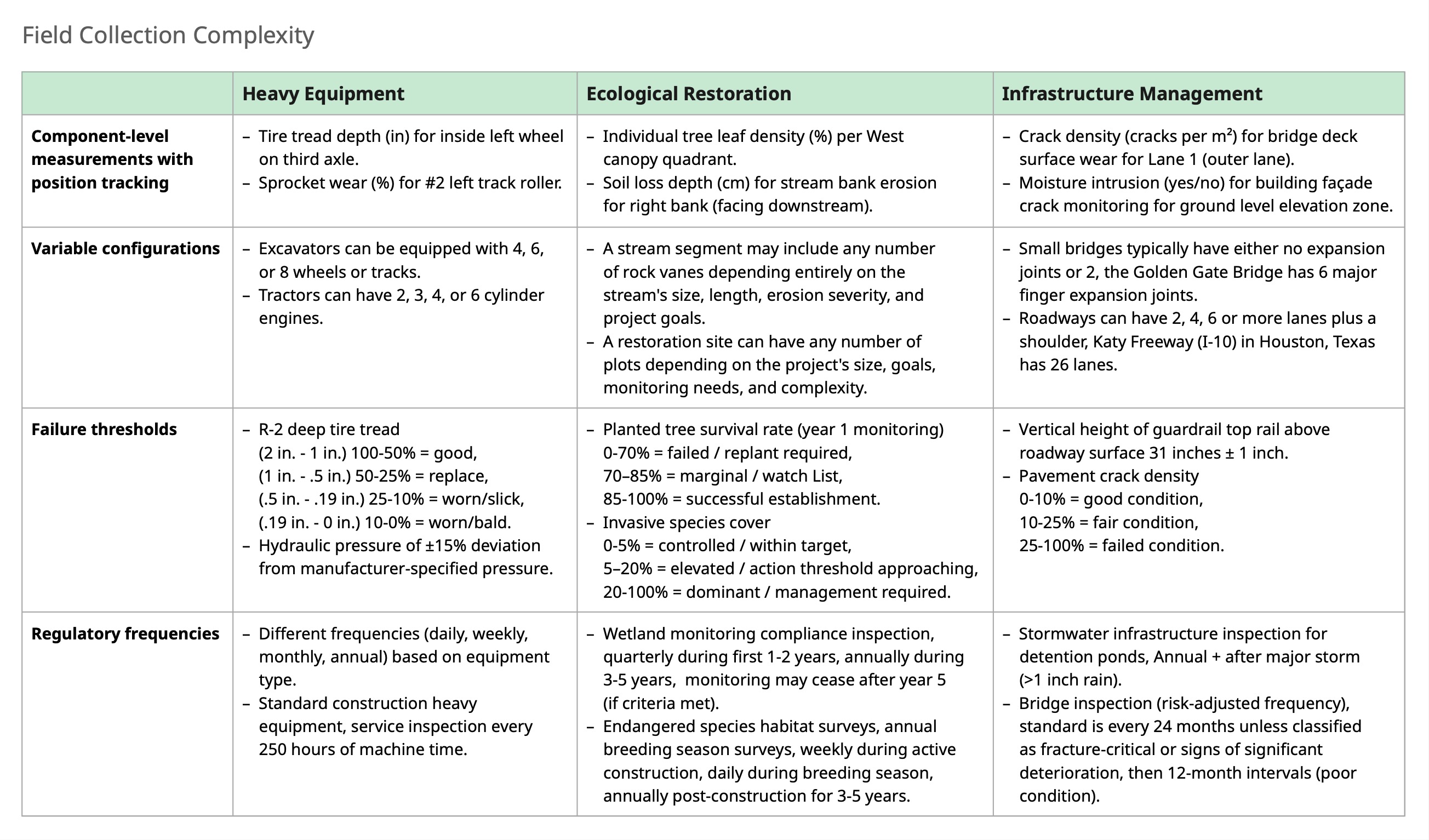
These patterns show up in ecological monitoring, heavy equipment inspections, and other domains.
Shared Structure Across Field Systems
Across domains, data has to carry reasoning over time.
Here’s how I designed the architecture so structured data could carry reasoning, accountability, and value over time. Without that structure, organizations operate reactively. One dealership absorbed $100K because they couldn't prove which components they had serviced.
The architectural challenge was creating data structures flexible enough to adapt to domain‑specific requirements, while remaining rigid enough to ensure consistency across time and enable mechanical comparison. Most solutions optimize for one or the other. I built both.
Business Impact
Trust, accuracy, and clear communication are essential to dealership operations. When data is collected without enforced structure, all three can degrade at every handoff.
In practice:
In one case, a dealership absorbed a $100K cost. They had to choose between that loss or risking a valued customer and the legal expense of defending which specific roller had been replaced.
When standards rely on manual processes (placing the burden on people rather than the system), the result is predictable: incomplete, inconsistent, and low‑quality data.
I redesigned the data architecture around two core decisions:
Industry-specific measurements with real-world tracking considerations
Instead of generic input fields, the system enforces measurement types that reflect how equipment is actually inspected. Managers define which measurements matter and how they must be recorded.
Highly flexible manager-controlled configuration
Managers build complex, domain‑specific inspections, controlling granularity (left rear brake pad vs. overall condition), failure thresholds, required evidence, and repetition patterns. The system adapts to different business needs while preserving consistency across time.
This architecture unlocked:
- $2.8M projected annual revenue through upgraded subscription model
- API integrations that support OEM partnerships and third‑party tooling, with the potential to double OEM specific subscribers
- Industry‑leading position strengthened through flexible configuration, domain‑specific tracking, and operational integration
- Entry into new markets previously unreachable due to legacy architectural constraints (non‑equipment, job site, and safety inspections)
Placeholder for assets:4 screenshots with annotations - legacy unstructured data entry + report, new structured data entry + report. Callouts showing the architectural shift.
Complexity Isn't the Problem; Allocation of Burden Is
Dismissing complexity doesn’t make solutions better. It makes correct problem framing impossible.
Most people assume heavy equipment inspections resemble car inspections: predictable configurations, standardized processes, and straightforward documentation. That assumption flattens the actual problem.
What Breaks When Systems Don't Match Reality
The gap between vehicle and equipment inspections is bigger than you might think:
| Standard Vehicle | Heavy Equipment |
|---|---|
| 4–8 wheels, enclosed cab with windshield/windows | Up to 16+ wheels or track-based (no wheels), may lack full cab, windshield, or windows |
| Strict public-road regulations determine size, age, and features | Varies drastically in size, age (100+ years), and features dependent upon task |
| Due to widely available parts and standardized labor: repairs typically cost hundreds to thousands; purchases range from thousands to low six figures | Due to specialized parts and labor: Repairs can cost hundreds of thousands; purchases reach millions |
| Annual or periodic inspections | Regulartory complexity: daily pre-shift inspections plus annual or scheduled/certifications |
| Designed for passenger safety in collisions (seatbelts, airbags, crash crumple zones, advanced driver assistance, and etc.) | Focus on operator safety and worksite hazards (for example, rollover protection, backup alarms, proximity sensors, lockout/tagout systems, unique failure risks including fatigue cracks, hydraulic failure, or etc.) |
| Designed for paved roads and within controlled, relatively predictable weather condition environments | Built for harsh/extreme conditions (mud, dust, debris, extreme heat/cold, constant vibration and shock loads, or etc.) |
| Limited customization (trim levels, aftermarket parts). Purpose is generally fixed (transportation). | Highly customizable: attachments (buckets, blades, drills, forks, etc.) or configurations tailored to specific tasks. Function can change significantly depending on setup. |
| Downtime affects individuals or small operations. Alternatives often available (rental cars, fleet backups). | Downtime can halt entire projects. High financial impact due to labor, scheduling, and project delays. |
| Repairs typically done in shops or dealerships. Scheduled during convenient times (business hours). | Repairs often in the field (remote sites), or during off-peak hours or overnight. Requires mobile technicians and specialized tools. |
Why This Matters
Generic form builders don't fail spectacularly. They quietly fail to support real workflows or scale with operational complexity.
My job was to see the full problem and design a foundation that could expand to fold in capabilities instead of tacking them on or destabilizing what exists. The solution doesn't eliminate complexity. It relocates it to places where people can actually manage it, track it, and confidently communicate about it.
Placeholder for assets:
2 screenshots - template builder showing grouped steps for 4 wheels, inspector view showing grouped steps for one wheel. Proves system handles complexity.
Driving Architectural Transformation
After nearly 40 years of accumulated, engineering‑led design decisions, our application was outdated, difficult to use, and lacked cohesion in both appearance and functionality. For more than a decade, the company has been migrating to a newer tech stack, prioritizing feature parity and visual modernization rather than alignment with real customer workflows.
I recognized this approach had limited effectiveness. The inspections module became my proof of concept: a complete architectural rebuild across backend, business logic, and frontend, demonstrating the limits of surface‑level modernization.
My research defined the requirements and phased execution plan. I made the case for adding it to the roadmap, then led Product and Development teams through execution, preventing scope creep while keeping execution grounded in customer‑validated workflows.
Organizational Alignment
I coordinated UX Design, UX Research, Development, and Product around workflow reference markers derived from customer research. This included structured discovery and site visits that surfaced what customers couldn't articulate.
I integrated perspectives from internal teams (Support, Sales, Customer Management, Training, and others) to ensure the system supported internal workflows alongside customer needs.
These reference markers acted as stable anchors. When priorities shifted or resources changed during the 4 years, teams could adapt implementation details without questioning the foundation. Backend developers could pivot database approaches. Frontend developers could challenge and improve designs. Product could adjust roadmap sequencing. The workflow anchors held.
This prevented decision churn and scope creep that typically derails multi-year transformations.
Capability Building
I created feedback loops that stretched team capabilities:
- Pushed backend developers to handle dynamic data collection complexity they hadn’t built before.
- Created space for frontend developers to challenge my designs. Their technical input often elevated outcomes beyond my original proposals.
- Built a new design system when existing systems couldn’t support the interaction complexity we needed (helper text patterns, advanced filtering, drag-and-drop interfaces).
The design system is now being implemented company-wide. The technical approaches developed here are influencing other teams' work.
Throughout 4 years of management changes and resource constraints, I maintained the organizational alignment and momentum that kept the transformation coherent. Continuous customer validation, internal team check-ins, and pushing teams past 'how we've always done it' sustained progress when priorities shifted and support wavered.
Placeholder for assets:
Overview workflow diagram (reference markers), technical diagrams (versioning/logic/excel for dynamic data), timeline showing interdependent workstreams across 3.5 years, possibly Miro research mapping
How the system works: Architectural Decisions
Three interconnected architectural decisions address the problems identified: unstructured data breaking communication, generic tools forcing workarounds, and workflows mismatched to field reality.
Component-level data structure with contextual metadata
Each measurement maintains persistent identity and captures how it was collected. When a manager defines “Tire tread depth” repeating across four wheels, the system creates four distinct database records.
Each record maintains its own step ID (persisting across template versions), wheel position, unit of measure, conversion option, and whether the data represents an actual measurement or an estimation.
This structure enables:
- Historical comparison across time. For example, June FL tire vs. December FL tire (same component, trackable change)
- Defensible evidence (measurement details + photos + failure threshold all tied to specific component identity)
- Quotes and work order integration (job code details on failed steps can be used to generate segments on new or existing quotes and work orders)
- Pattern analysis (individual unit trends and fleet-wide insights)
Manager-controlled configuration with industry-specific inputs
Managers define what to measure without having to think about how to build a generic form. Manually building generic options, followed by continued maintenance, takes time and adds cognitive load.
My approach delivers:
- Standardized data collection ensures inspectors enter consistently formatted data, improves data quality, and reduces the risk of communication breakdown
- 86% reduction in template creation time (3 hours to 20 minutes) using controls that eliminate manual repetition entries, enable quick construction from reusable sections, and streamline reorganization
- Control without technical assistance (simple configuration for complex form design)
- Flexible granularity to meet any business need (from general condition checks to precise measurement tracking)
- Repetition patterns that propagate automatically through grouping
Grouping inheritance for workflow efficiency
Within the template managers can group related steps. The system presents these steps together during the inspection. For example, if tire tread depth and tire pressure are grouped and repeated for four wheels, the inspector will see both of these steps when inspecting the front left wheel, then both again at the rear left wheel and so on.
This matches physical inspection workflow:
- Inspector checks each specified occurrence once, completing all steps in the group
- Reduces cognitive load since repeated steps follow a natural flow (all left side wheels, then right side)
- Saves time since grouped steps can be performed together
How they interconnect:
Component-level structure gives grouping its meaning. Each grouped instance maintains permanent identity for comparison and integration. Manager configuration defines what component instances exist and how they're organized.
Grouping shapes efficient data collection while preserving the granular tracking that makes data actionable and trustworthy.
Together, these decisions move complexity into the system architecture where it can be managed consistently, freeing managers to define business‑critical standards, inspectors to collect data efficiently, and service teams to act on patterns and recommendations.
Placeholder for assets
Data structure diagram for one complex step, manager configuration screenshots, grouping screenshots (already covered in section 3), interconnection diagram showing the three decisions working together
System Scalability
The architecture was designed for expansion, not just initial delivery.
Integration architecture: Built with defined integration points that support future cloud architecture and microservices, ensuring the system can evolve alongside platform migration.
Extensible foundation: The template builder's data structure accommodates new input types without requiring backend restructuring. As needs evolve, the system adapts without architectural overhaul.
Workflow flexibility: New inspection types (non‑equipment, job site, safety) fold into the existing architecture rather than being bolted on. The underlying data structure and workflow patterns support any new context.
New business models: OEM partnership discussions are underway for API access to map OEM models to template creation and transmit report results into OEM inspection systems.
The system addresses more than today’s problems. It establishes a foundation for capabilities not yet on the roadmap.
Team Transformation
Organizational proof: $2.8M in revenue, new markets, and industry positioning demonstrate the value of customer‑led design over surface‑level modernization.
Architectural patterns: This approach established repeatable patterns for system redesign during platform migration. Teams now have a model for customer-led architecture that scales.
Development productivity: A clear architectural vision eliminated debate cycles and surfaced dependencies early, allowing teams to focus on execution rather than constant replanning.
Design system maturity: Since components were built under real-world complexity, they are now being implemented company-wide with confidence.
Customer Workflows
The work didn't change. Where the burden lives changed.
Managers before: Limited to templates they could afford time to build, or templates requiring vendor assistance for complexity.
Managers after: Build any inspection needed, simple or complex, in minutes. Modify standards as business needs shift without technical dependency.
Inspectors before: Interpret vague requirements, remember thresholds, decide what constitutes failure, document in inconsistent formats.
Inspectors after: Measure current state. The system enforces structure, validates thresholds, and triggers requirements. Cognitive load shifts from interpretation to observation.
Service writers before: Read through inconsistent notes, interpret what failed, manually create work order line items, re-enter data.
Service writers after: Review structured failures with measurements, photos, and assigned job codes. Push supporting details to quotes or work orders without manual entry.
The system now carries the burden of consistency, validation, and integration across workflows. People focus on judgment that requires their expertise.
Placeholder for assets
Work order linking diagram, Storybook screenshots, Assign Service screen, capabilities list, beta tester feedback form
Conclusion
Ecological restoration and heavy equipment are complex domains that depend on human judgment and expertise. Tools that serve these domains only gain true impact when real work patterns shape the system's structure.
This case study demonstrates how my principles translate into architecture by producing systems that support expertise rather than eroding it.